
Review · CAMBODIA
2 Days Exclusive Temple Highlights with Sunset and Sunrise Tour
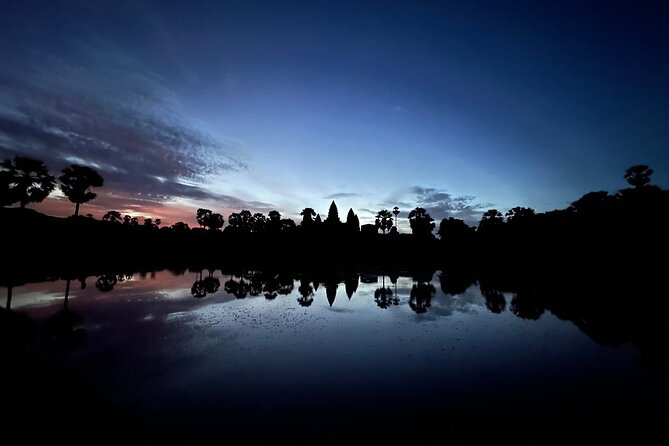
Angkor Wat at sunrise is the headline, but the clever part of this tour is the order. You visit outlying temples such as Banteay Srei and Preah Khan first, then save Angkor Wat for the second morning, when the grandest sight arrives fresh rather than feeling like one more stop on a long temple day.
I like the balance of air-conditioned transport and real walking time. Guides such as Pal, Chhay, Sokpee, and Sak are praised for explaining Cambodian history and daily life without filling every minute with talk. I also like the small comforts: steady supplies of bottled water, cold towels, photo help, and regular bathroom breaks.
The main catch is price. The advertised $49 does not include the required $62 temple pass, and meals are extra. Two days can also feel full and energetic, especially if you are not used to heat, uneven stone, and an early alarm.
Five useful things to know before you book
- Angkor Wat comes on day two at sunrise: You enter before dawn, so bring a torch and prepare for a very early start.
- The $49 price is not the final cost: Add the $62 two to three-day temple pass, plus meals and drinks.
- Banteay Srei is a major highlight: Its small scale and fine sandstone carving provide a welcome change from the giant temple ruins.
- The pace is busy but planned: You see many important sites without trying to cram every major temple into one day.
- Comfort matters here: Air conditioning, bottled water, cool towels, and hotel pickup take the edge off Cambodia’s heat.
- Sunset depends on the option you choose: Small-group arrangements include sunset at Phnom Bakheng, while the private option lists a rice-field sunset at Baitang.
Why the two-day order works so well
A one-day Angkor visit can leave you with a blur of towers, galleries, and stone faces. This two-day plan gives the main sights room to breathe. Day one reaches farther from the central Angkor area, while day two focuses on the sites most first-time visitors want to see.
I like ending the second morning with Angkor Wat rather than using it as a quick opening stop. You have already learned how Khmer temple plans work, so the scale of Angkor Wat becomes easier to appreciate. The downside is that day two starts before dawn and still contains several major sites afterward.
The tour is sold at $49 per person, but that is only the operator’s fee. The required temple pass costs another $62 per person and is paid directly at the site. That brings the known entry and tour cost to $111, before food and drinks. At that total, the value comes from the guide, transport, timing, and amount covered, not from cheap entry to the ruins.
More Sunrise and Sunset Tours in Cambodia
- Angkor Wat Sunrise or Sunset Tour with Guide from Siem Reap
★ 5.0 · 12,109 reviews - Siem Reap: Angkor Wat: Small-Group Sunrise or Sunset Tour
★ 5.0 · 9,444 reviews - Siem Reap: Angkor Wat 2-Day Tour with Sunrise and Sunset
★ 4.9 · 4,429 reviews
Day one begins at Pre Rup
Pre Rup is a strong opening temple because it introduces the temple-mountain design used across Angkor. Built for King Rajendravarman and dedicated in 961 or early 962, it combines brick, laterite, and sandstone.
You have about an hour here. Expect stairs, open stone, and a useful first lesson in how the Khmer built upward toward a symbolic center. Pre Rup is not as famous as Angkor Wat, which is part of its appeal. It lets you get your bearings before the larger crowds and bigger names arrive.
The exposed upper levels can feel hot. Wear shoes with a firm sole and take care on the steps. The temple pass is not included at this stop, or at most of the temple stops, so keep that extra cost in mind from the start.
Banteay Srei rewards close attention
The drive to Banteay Srei takes you away from the central group of Angkor temples. The reward is a smaller sandstone temple with exceptionally fine carving. You get about two hours here, enough time to study the reliefs rather than simply walk around the outer walls.
This is often the day one highlight for people who enjoy detail. Banteay Srei is sometimes called the Lady Temple, and its carefully cut decoration feels more delicate than the broad stone galleries at Angkor Wat. I would not rush this stop. Look closely at the carved figures, floral patterns, and the way the reddish stone catches the light.
The setting also changes the feel of the day. After the monumental scale of Angkor, Banteay Srei offers something more intimate. You still need to walk in the heat, and there is no meal included, so carry the bottled water provided and plan to buy food separately.
Neak Pean brings water into the story
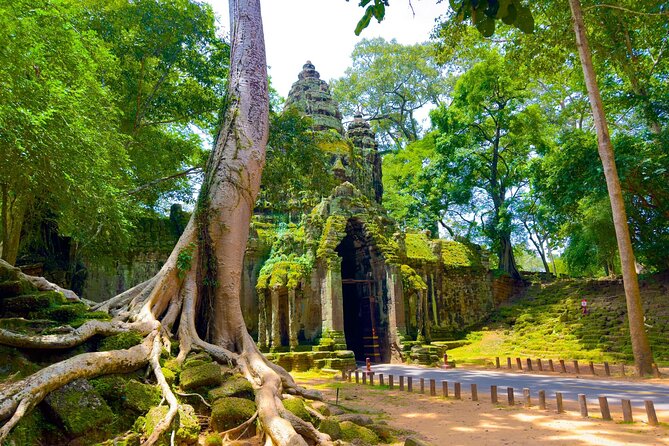
Neak Pean takes about an hour. It is an artificial island with a Buddhist temple, reached across a long approach over water and wet ground.
This stop is less about a huge ruin and more about design. The water setting gives your eyes a break from walls and towers. It also shows how Khmer religious sites could connect architecture, water, and belief.
Some people will find Neak Pean quieter and less dramatic than the larger temples. I see it as a useful pause in a full day, especially because the itinerary soon moves to the more atmospheric Preah Khan.
More Sunrise Temple Tours in Cambodia
- Angkor Wat Sunrise & 3 Main Temples with Breakfast – Small Group
★ 5.0 · 2,857 reviews - Siem Reap: Angkor Sunrise 1- or 2-Day Guided Temples Tour
★ 4.9 · 1,132 reviews - Siem Reap: Angkor Wat Sunrise Explore The Most Iconic Temples
★ 5.0 · 879 reviews - Siem Reap: 2-Day Temple Highlights Sunrise and Sunset Option
★ 4.9 · 445 reviews
Preah Khan is the atmospheric afternoon stop
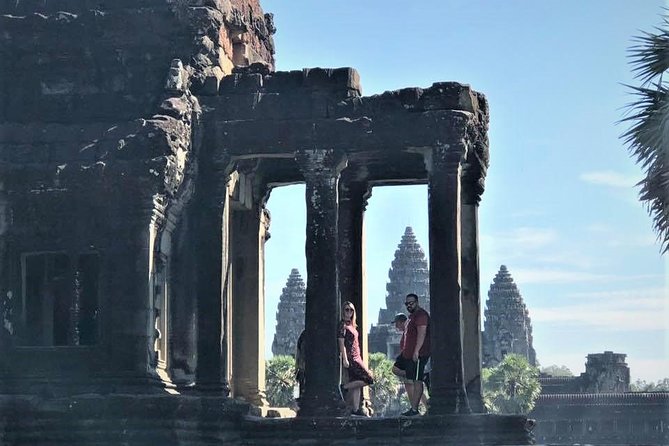
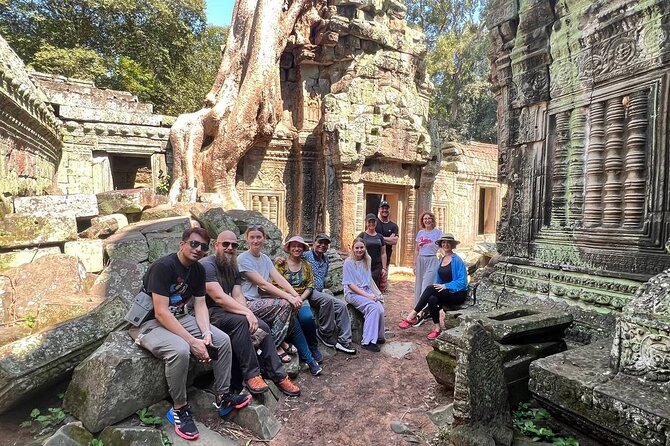
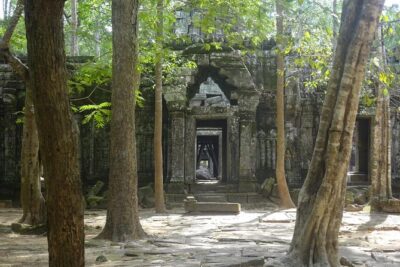
Allow two hours for Preah Khan, a broad ruin where tree roots and crumbling stone create the mood many people hope to find at Angkor. It was once an important religious and educational center, and its long corridors reward a slower walk.
This is a good place for your guide to explain how a temple complex worked beyond its central shrine. You can ask about the layers of religious use, the buildings around the main sanctuary, and the effect of centuries of weather and vegetation.
Preah Khan is also where the tour’s walking demands become clear. Surfaces can be uneven, and the complex is large enough to tire you after three earlier stops. Comfortable walking shoes are not a minor suggestion here. They make the difference between enjoying the final corridors and simply looking for the exit.
Sunset offers two different experiences
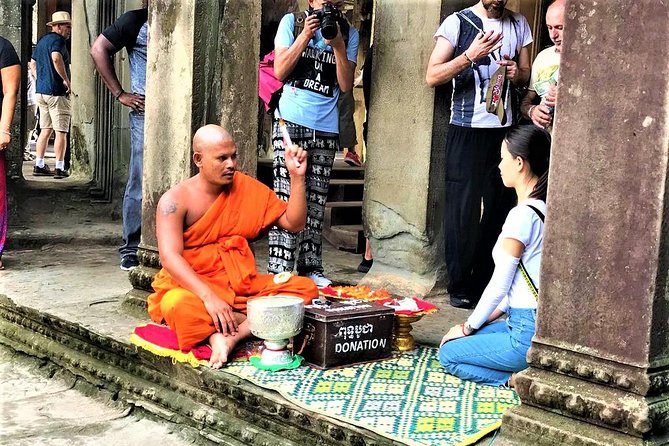
The final stop on day one changes according to the booking option. The private option lists Baitang in Siem Reap, where you relax among rice fields, have a cold drink, and enjoy a light local setting as the sun goes down. The small-group option lists sunset at Phnom Bakheng Mountain.
These are not interchangeable experiences. Baitang is a calmer countryside pause, while Phnom Bakheng is a well-known temple viewpoint. If sunset is important to you, confirm which option you are buying before paying.
The sunset stop is useful because it gives you a softer finish after a demanding temple day. You are not simply walking until dinner. You get a change of pace and a chance to let the day settle.
The pre-dawn Angkor Wat start
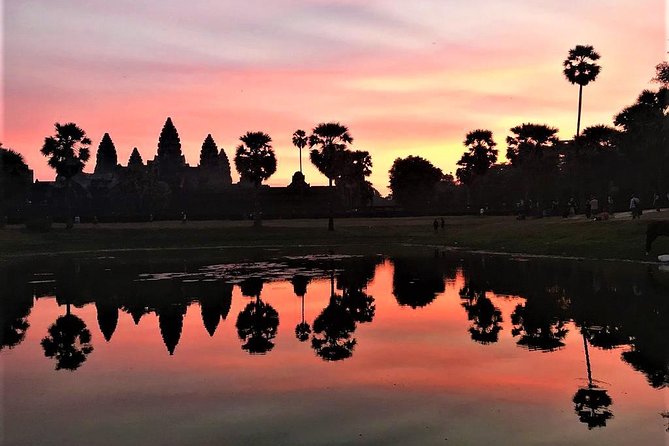
Day two begins before sunrise. You enter Angkor Wat in darkness from the less-used eastern side, and the tour information specifically tells you to bring a torch. Do not treat this as a normal morning departure. Pack your clothes and shoes the night before, and keep your phone or torch easy to reach.
The reward is seeing Angkor Wat as the sky changes behind its famous towers. Sunrise conditions vary, so no tour can promise a perfect reflection or clear colors. The early start still matters because the temple feels different before full daylight and before the day’s heat builds.
You have about three hours here. That gives you time for the sunrise setting, the approach, and parts of the temple interior. Your guide can put the carvings, galleries, religious purpose, and construction into context, while you still get time to explore independently.
Angkor Wat is not a quick photo stop. It is a large complex, and the walking can be tiring. Cover your shoulders and knees before you arrive. A scarf over bare shoulders is not accepted as a substitute for proper coverage, and entry can be refused if you do not follow the dress rules.
Ta Prohm delivers the famous jungle setting
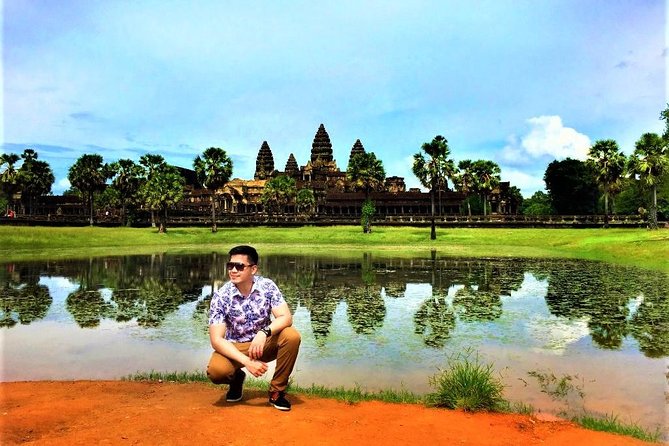
After Angkor Wat, the tour moves to Ta Prohm for about two hours. This is the temple most associated with roots, trees, and stone walls being slowly overtaken by vegetation. It was once home to 2,740 monks, a detail that helps you picture the site as a working religious community rather than a silent movie set.
Ta Prohm is visually powerful, but do not expect to have every spot to yourself. The most famous tree-and-stone views draw attention. A good guide helps you see beyond the best-known photo points and understand the layout.
This is another stop where sturdy footwear helps. Roots, broken stone, and uneven paths require attention. The tour provides transport between temples, but you still spend much of the day on foot.
Ta Nei is the quieter change of pace
Ta Nei is a late 12th-century stone temple in Angkor, reached in the afternoon, with about an hour set aside. It is smaller and less grand than Angkor Wat or Ta Prohm.
That difference is exactly why it belongs here. After two famous sites, Ta Nei gives you a more restrained look at Angkor architecture. You can focus on stonework and setting without the same sense that you are trying to cover a huge complex.
Do not book this tour expecting every stop to be a blockbuster. Ta Nei works as a quieter contrast, and its value depends on your interest in seeing more than the standard three or four temples.
Angkor Thom brings the empire to a grand scale
The tour then reaches Angkor Thom, the former Khmer capital. You have about an hour and a half for the main area, with additional time to pass the Terrace of the Elephants and the Terrace of the Leper King.
The scale changes again. Angkor Thom is not just one temple. It is a walled royal city, and the broad plan helps you understand how power was organized around the central monuments.
The Bayon is the major focus here, with its carved faces and dense stone towers. Give yourself time to look up and around. The lower passages can feel busy and visually crowded, while the upper structures reward patience.
The guide’s role is especially useful at Angkor Thom. Without context, it can be hard to tell which parts served royal, religious, or civic purposes. Guides such as Chhay, Pal, Sak, Sokpee, and Sok are praised for explaining both temple details and Cambodian life, which adds more meaning to a place this large.
The South Gate closes the temple circuit
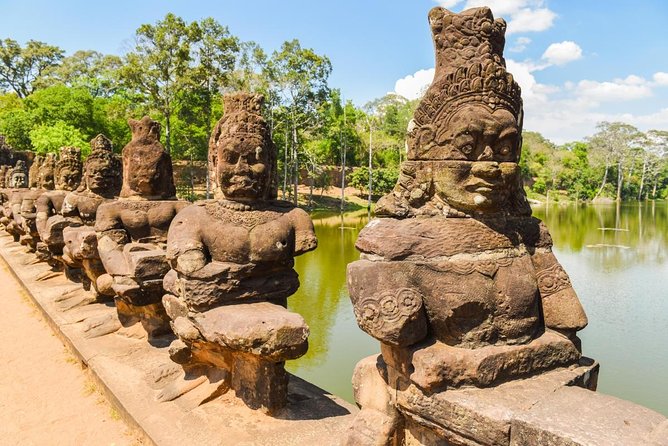
The final listed stop is the South Gate of Angkor Thom, with about 30 minutes. Its causeway and entrance figures provide a fitting last look at the city’s monumental design.
You may already be tired by this point. That is not a flaw in the guide so much as the nature of the two-day plan. The itinerary covers a lot, and the South Gate is a short final visit rather than another long interior tour.
The order also makes practical sense. You finish with a major gateway and the memory of Angkor Thom’s scale, rather than adding another distant temple when your attention and legs are running low.
Guides, vehicles, and the small comforts
The experience includes an English-speaking guide and an air-conditioned vehicle. Hotel pickup and drop-off are included when that option is selected, so check the exact booking choice rather than assuming every fare has identical transfer terms.
The driver is a major part of the day. Names associated with this operation include So, Vichet, Mao, Seyha, Ro, Benly, and Keal. The strongest practical details are simple: drivers are described as careful, punctual, friendly, and generous with water and cold towels.
The tour can run as a small group, with one booking reporting only six people, or as a private experience depending on the option selected. A small group can lower the price and make the long days more social. A private tour gives you more control over pace and personal time.
Guide quality can vary by assignment, but the named guides connected with this experience are repeatedly praised for clear explanations, photo help, patience, and good time management. Pal Saruon, for example, is noted for balancing temple information with time to explore on your own. That balance matters. A guide who talks without pause can make even a great temple tiring.
Food, clothing, and what to pack
Meals and drinks are not included. Food stops may be arranged during the day, but you choose and pay for what you eat. One practical caution is that food at stops connected with a tour can cost more than similar meals in central Siem Reap, so bring extra money and do not assume lunch is part of the $49 fare.
Pack:
- A torch for the pre-dawn Angkor Wat entry
- Comfortable walking shoes
- Clothing covering shoulders and knees
- Sun protection
- Money for the temple pass, meals, and drinks
- A small bag for your phone and camera
Bottled water and cool towels are provided, which is especially welcome in the heat. Regular opportunities to use the bathroom are also built into the day, according to the practical details of the experience.
Most people can take part, but children must be accompanied by an adult. The combination of early starts, long walks, heat, and temple steps means you should judge the pace against your own fitness.
Who gets the best value from this tour
I would choose this tour if you have two days in Siem Reap and want a guided introduction without spending time arranging drivers, routes, and temple order yourself. It covers the famous sights, but it also includes Preah Khan, Neak Pean, Ta Nei, and Banteay Srei.
It suits first-time visitors especially well. You get historical and cultural explanation, transport between scattered sites, and help finding photo positions without having to learn the whole Angkor map in advance.
It is less suited to you if you want slow photography, long meals, or a flexible schedule. Two days cover a lot, and the sunrise morning is demanding. A private option is the better choice if you want to adjust the pace or spend longer at one temple.
Cancellation is free if you cancel at least 24 hours before the start time. Changes or cancellations inside that window are not accepted for a refund.
Should you book it?
Book it if your priority is to see the main Angkor temples and several less obvious stops in two well-planned days. The tour’s best features are its temple order, strong guide support, air-conditioned transport, and practical care with water and towels.
Before booking, check three things: the required $62 temple pass, the sunset location attached to your option, and whether you are choosing small-group or private transport. If you accept the early start and full walking schedule, this is a useful and well-priced way to get your first clear picture of Angkor.
FAQ
Is the temple pass included in the $49 price?
No. A two to three-day temple pass costs $62 per person and is paid directly at the site.
Are meals included?
No. Food and drinks are not included. You can purchase them at your own expense during the tour.
Does the tour include hotel pickup and drop-off?
Hotel transfers are included when the pickup and transfer option is selected. Check the option details when booking.
Is the tour private or shared?
The experience can be offered as a small-group tour or as a private tour, depending on the option selected. The private option allows you to go at your own pace.
What time does Angkor Wat begin?
Day two starts before dawn for sunrise. You should bring a torch because the temple entry begins in darkness.
What should I wear to the temples?
Your shoulders and knees must be covered. This rule applies to men and women. A scarf used to cover bare shoulders is not accepted, and entry may be refused if you do not meet the dress requirements.
Is bottled water provided?
Yes. Bottled water and cool towels are included during the tour.
Can children join the tour?
Yes, most people can participate, but children must be accompanied by an adult.
More Sunrise and Sunset Tours in Siem Reap
- Angkor 2-Day Sunset & Sunrise Small-Group Tour
★ 5.0 · 2,567 reviews - Siem Reap: Angkor Wat Sunrise or Sunset Guided Tour
★ 4.9 · 2,123 reviews - Angkor Sunrise or Sunset Tour (includes breakfast or lunch)
★ 4.8 · 144 reviews - Angkor Wat: Sunrise or Sunset Tours with Tuk Tuk
★ 5.0 · 103 reviews
More Sunrise Temple Tours in Siem Reap
- 1-Day Angkor Wat Sunrise & All Interesting Temples Private Tour
★ 5.0 · 174 reviews - From Siem Reap: Angkor Wat Sunrise and Temples E-Bike Tour
★ 5.0 · 52 reviews - Sunrise at Angkor Wat Temple: 3-Hour Private Tour
★ 4.7 · 30 reviews - Siem Reap Angkor Wat Sunrise Explore The Most Iconic Temples
★ 4.8 · 20 reviews
Newly added sunrise trips around Siem Reap
- Sunrise at Angkor Wat with a sharing group★ 5.0 · 2 reviews
- Sunrise at Angkor Wat Temple: 3-Hour Private Tour★ 4.7 · 30 reviews
- Sunrise at Angkor Wat and Full day with Fascinating Temples★ 5.0 · 2 reviews
- Small-Group Explore Angkor Wat Sunrise Tour with Guide★ 5.0 · 3 reviews
- Siem Reap Temple Tour 2-Day with Sunrise/Sunset★ 3.7 · 3 reviews
- Angkor Wat: Sunrise 2.5 Days Temples & Tonle Sap-Small Group★ 5.0 · 10 reviews
- Siem Reap: Angkor Wat Sunrise Tour via Tuk Tuk & Breakfast★ 5.0 · 29 reviews
- Siem Reap: Angkor Wat Sunrise Tour with Spanish Guide★ 5.0 · 18 reviews
Sunrise Temple Tours, compared at first light.
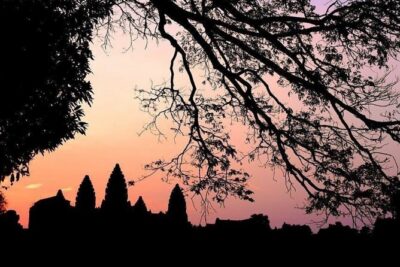
Angkor Wat Sunrise & 3 Main Temples with Breakfast – Small Group
Read our review →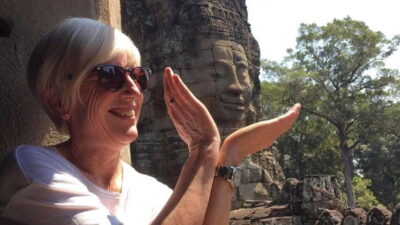
Angkor Sunrise 1- or 2-Day Guided Temples Tour
Read our review →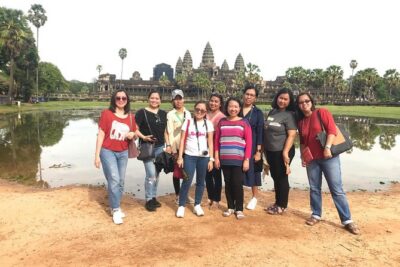
Angkor Wat Sunrise Explore The Most Iconic Temples
Read our review →
North Bali: Sunrise Tour with Dolphins, Waterfalls & Temples
Read our review →
From Sharm: Mount Moses Trekking, Sunrise & Monastery Visit
Read our review →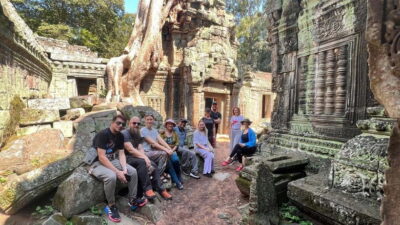
2-Day Temple Highlights Sunrise and Sunset Option
Read our review →
1-Day Angkor Wat Sunrise & All Interesting Temples Private Tour
Read our review →More lists with this sunrise on them